Executive & Non Directorship

EXECUTIVE VS. NON-EXECUTIVE INDEPENDENT DIRECTORS: ROLES, LIABILITIES, AND LEGAL CONSIDERATIONS
Introduction
Corporate governance relies on a well-structured board
of directors that balances executive management with
independent oversight. A company’s board typically consists of Executive Directors (EDs), who manage day-
to-day operations, and Non-Executive Independent Directors (NEIDs), who provide independent oversight.
While their roles and responsibilities differ, both owe
fiduciary duties to the company and can be held legally
accountable for corporate failures. This article explores
the differences between EDs and NEIDs, their liabilities,
and legal protections available to them.
1.Role and Responsibilities of a Non-Executive Independent Director (NEID)
NEIDs play a governance and oversight role, ensuring that the company is managed transparently and ethically. Their responsibilities include:
- Independence from management: NEIDs must not participate in day-to-day operations or have material financial or personal interests that could compromise their objectivity.
- Board advisory role: NEIDs provide external perspectives and strategic guidance, ensuring alignment with shareholder interests.
- Performance monitoring: They assess and hold executive management accountable for corporate performance and risk management.
- Committee membership: NEIDs often serve on keyboard committees such as audit, remuneration, and nomination committees, where their role is crucial in upholding transparency and governance standards.

Legal Reference:
- Malaysia: Bursa Malaysia Listing Requirements mandate that public-listed companies have at least one-third independent directors.
- UK: The UK Corporate Governance Code (2020) recommends that boards of FTSE-listed companies be composed of at least 50% independent non- executive directors.
- US: Under the Sarbanes-Oxley Act 2002, public companies must have an independent audit committee composed solely of non-executive directors.
2. Role and Responsibilities of an Executive Director (ED)
EDs are actively involved in company operations and decision-making. Their primary duties include:
- Operational execution: EDs implement business strategies and oversee financial performance.
- Leadership positions: EDs often hold C-suite roles (e.g., CEO, CFO, COO) and are responsible for daily management.
- Financial interest: Unlike NEIDs, EDs may receive performance-based compensation, such as stock options, bonuses, and equity stakes.
Legal Reference:
- Malaysia: Under the Companies Act 2016, EDs have statutory duties to act in the company’s best interests, including obligations under Sections 210- 218 on directors' fiduciary duties.
- US & UK: EDs are bound by fiduciary duties of care and loyalty, as established under corporate governance frameworks.
3. Differences in Risk and Legal Liabilities
Fiduciary Duties and Liability Exposure
Both NEIDs and EDs owe fiduciary duties to the company and shareholders, including:
- Duty of care–Acting prudently in decision- making.
- Duty of loyalty–Avoiding conflicts of interest.
- Duty of compliance–Ensuring adherence to laws and regulations.
However, their liability exposure differs: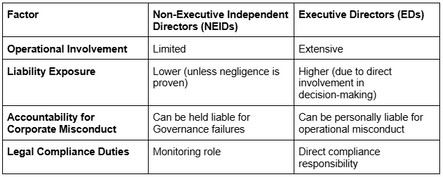
4. Indemnification and Legal Protections for Directors
Given the risks, companies often provide indemnification and Directors & Officers (D&O) liability insurance to shield directors from personal liability.
Key Legal Protections:
- Indemnification clauses: Companies can indemnify directors against legal costs and claims, provided there is no fraud or gross negligence.
- Insurance: Protects directors from lawsuits arising from business decisions, except in cases of fraud or wilful misconduct.
5. Corporate Governance Best Practices for Directors
To mitigate risks and enhance board effectiveness, companies should implement best practices, such as:
- Separation of CEO and Chair roles – Ensuring independent oversight.
- Regular board evaluations – Assessing director performance.
- Mandatory director training – Improving awareness of governance responsibilities.
Conclusion
Both executive and non-executive independent directors play essential roles incorporate governance. While NEIDs focus on oversight and accountability, EDs handle daily operations and carry greater liability exposure. Companies must ensure robust governance frameworks, indemnification provisions, and regular compliance monitoring to protect directors and enhance board effectiveness. Strengthening independent directorship and adherence to fiduciary duties will help mitigate legal risks and uphold shareholder confidence.